

The energy labels and the energy classes
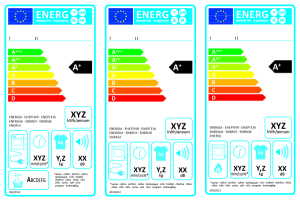
The old energy label, still applicable until the 30th of June 2025, includes three different energy label designs for condenser dryers with heat element or heat pump, air-vented dryers and gas-fired dryers.
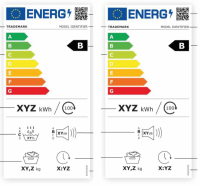
The new regulation only includes two energy label designs for condenser and non-condenser dryers.
Regulation (EU) 2025/1353 further amends these labels by introducing an additional repairability class from the 1st of January 2027 onwards.
In the table below you can compare the design and content of the old and the new energy label:
| Energy labels until the 30th of June 2025 | New energy labels from the 1st of July 2025 (upper) and 1st of January 2027 (lower) | |
| Energy label design |
 |
From 1st of January 2027 (voluntarily from 24th of November 2025): 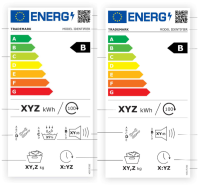 |
| QR code | Not available | Link to EPREL entry |
| Efficiency classes | A+++ to D | Classes A to G |
| Energy consumption | Shown in kWh/annum per 160 drying cycles plus low power mode consumption | Shown in kWh per 100 drying cycles (without low power mode consumption) |
| Repairability | Not available | Repairability class A to E shown on the label from 1st of January 2027 onwards (The lower energy labels) |
| Condensation efficiency | Classes A to G | Classes A to D and indication as percentage |
| Noise Level | Noise level for the standard cotton programme in dB (A) | Noise level for the eco-programme in dB (A) plus indication of 4 classes A to D |
| Rated capacity | Shown in kg for the standard cotton programme | Shown in kg for the eco programme |
| Duration of the energy saving programme | Energy saving programme designated as the standard cotton programme at full load. Duration shown in minutes. | Energy saving programme designated as the eco programme at full load. Duration shown in h:mm. |
| Energy source | Energy source (electricity or gas) indicated as icon | No indication of energy source (gas/electricity) on the label |
| Number of the regulation | (EU) 392/2012 |
Efficiency classes of the current and the new energy label
The following tables show the efficiency levels for the various efficiency classes for energy efficiency, condensation efficiency and acoustic airborne noise emissions.
Energy efficiency
| Old regulation (EU) 392/2012 | New regulation (EU) 2023/2534 | Remarks | |||||
| Class | EEI (old formula) | Weighted energy consumption per drying cycle (3/7 full load, 4/7 half load) | EEI (new formula) | Weighted energy consumption per drying cycle (24% full load, 76% half load) | |||
| A+++ | < 24 | < 0,21 * | * c0,8 | n.a. | |||
| A++ | < 32 | < 0,28 * | |||||
| A+ | < 42 | < 0,3675 * | |||||
| A | < 65 | < 0,56875 * | ≤ 43 | ≤ 0,1978 * | * c0,63 | Only condenser dryers with heat pump and gas-fired dryers | |
| B | < 76 | < 0,665 * | ≤ 50 | ≤ 0,23 * | |||
| C | < 85 | < 0,74375 * | ≤ 60 | ≤ 0,276 * | |||
| D | ≥ 85 | ≥ 0,74375 * | ≤ 70 | ≤ 0,322 * | |||
| E | n.a. | ≤ 85 | ≤ 0,391 * | ||||
| F | ≤ 100 | ≤ 0,46 * AV * | Only dryers with c ≤ 3 kg | ||||
| G | > 100 | > 0,46 * AV * | |||||
c = Full load capacity of the standard cotton resp. eco-programme
AV is a factor for air-vented dryers (with c ≤ 3 kg): AV = (1 – Tt/60 * 0,083), i.e. it reduces the displayed class threshold between F and G by 8,3% per hour of weighted (24% full load, 76% half load) duration of the eco-programme.
Repairability class (from 1st of January 2027 onwards, (EU) 2025/1353)
| Repairability class | Repairability Index (R) |
| A (most repairable) | R > 9.00 |
| B | 7.00 ≤ R ≤ 9.00 |
| C | 5.00 ≤ R < 7.00 |
| D | 3.00 ≤ R < 5.00 |
| E (least repairable) | R < 3.00 |
Condensation efficiency
| Condensation efficiency class (only for condenser tumble dryers) | Weighted condensation efficiency (24% full load, 76% half load) |
| A (most water caught and kept in the dryer) | Ct ≥ 94 |
| B | 88 ≤ Ct < 94 |
| C | 82 ≤ Ct < 88 |
| D (most water emitted to the surrounding air) | Ct < 82 |
Airborne acoustic noise emissions
| Efficiency class | Full load noise emissions (dB(A)) |
| A (most silent) | LWA ≤ 60 |
| B | 60 < LWA ≤ 64 |
| C | 64 < LWA ≤ 68 |
| D (noisiest) | LWA > 68 |